
Highlighting Home Efficiency Boosts Value
Homebuyers pay up to $10K more for energy efficiency, and other learnings from analyzing 143 million property listings
Here at 257, we work with hundreds of companies across the U.S. who share our mission to accelerate residential electrification and the clean energy transition.
These companies offer solar, storage, heat pumps, financing, energy management tools, and more – all to lower their customers’ energy bills and build a stronger grid.
The loss of federal incentives for home energy upgrades has made it all the more important to quantify the ROI of these impactful but investment-grade products.
According to EnergySage, while upfront installation costs vary widely, a U.S. homeowner today pays around $30,500 for rooftop solar and $14,529 for a ducted heat pump before incentives.
Data nerds that we are, we embarked on a study to learn if, in addition to near-term bill savings, large home energy improvements like rooftop solar and heat pumps would attract homebuyers and improve home values.
What we found: homebuyers seek out energy-efficient homes, and are willing to pay more for them.
This presents an untapped opportunity for solar installers, HVAC contractors, and manufacturers to educate prospective customers on the true value of their investments and help them capture thousands of dollars more when they sell their homes.
Our research and key findings
We analyzed 143 million U.S. home listings nationwide from 1995-2025 for mentions of “energy efficiency” and specific clean energy features.
We then performed two causal inference studies to learn if including solar- or heat pump-related language in a listing increased sale price.
Our findings are part of a larger report, “Home Buying in the Energy Transition,” released by the Smart Energy Consumer Collaborative (SECC) with additional insights from the National Association of REALTORS® and E Source.
You can download the full report for free here, or read on for the 257 highlights. You can also find more detail on our methodology toward the end of this article.
Homebuyers pay measurably higher sale prices for solar and heat pumps
Our analysis showed that on average, for homes with solar panels sold between 2024-2025, listings that explicitly mentioned solar garnered a 2% uptick in the final sale price, or the equivalent of +$10K per home (approximately one-third of the cost of a rooftop solar system) on a median sales price of $557K.
Meanwhile, for homes with ducted heat pumps that sold between 2024-2025, listings that mentioned heat pumps were also associated with higher sale prices, selling for 0.6% to 1% more, on average, or +$2.3K to +$3.9K per home (16-27% of a ducted heat pump investment) on a median sales price of $399K.
Put another way, when real estate listings clearly advertised solar or heat pumps, they commanded higher sale prices compared to similar homes that also had these features but failed to market them.
This suggests that homebuyers not only appreciate energy efficiency – given surging energy rates and growing affordability concerns across the nation, they actively seek it out when shopping for a new home.
In fact, our “Home Buying in the Energy Transition” co-contributor E Source found that 61% of recent homebuyers ranked energy efficiency as a top-3 consideration when house hunting.
92% of real estate listings don’t mention energy-efficient assets
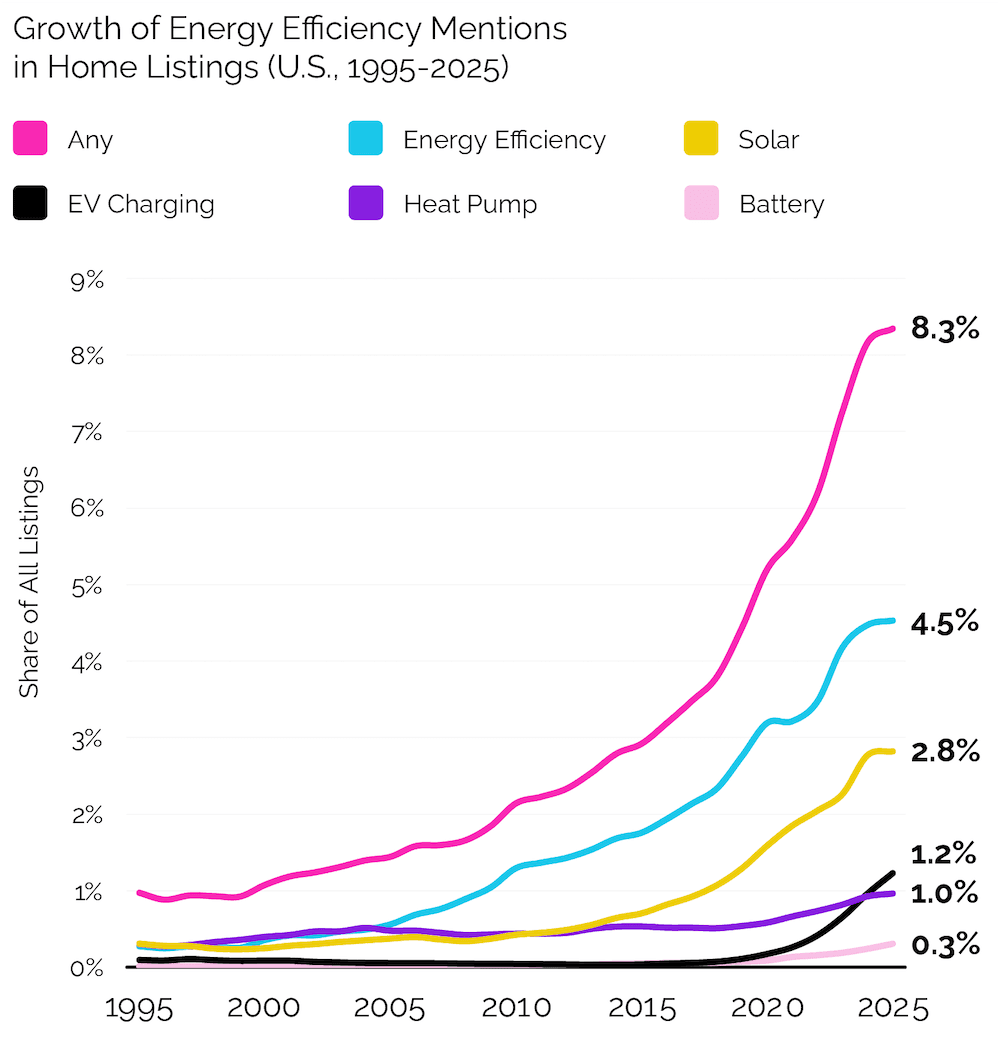
But based on our research, current homeowners underestimate the appeal of their energy-efficient assets. Despite the proven financial advantages of advertising energy efficiency, only 8% of 2025 listings did so.
Meanwhile, approximately 25% of U.S. residences have at least one large or particularly impactful asset such as solar, storage, a heat pump, smart thermostat, or EV charger, and millions more have LED lighting, insulation, smart appliances, and other tech that improves efficiency in some way, big or small.
Said another way: only one-third of listings that can boast energy efficiency actually do.
Encouragingly, the share of listings with any energy efficiency mentions nearly tripled between 2015 and 2025 (+186%), indicating not only that adoption of these features has accelerated but that homeowners are becoming more aware of the market for them.
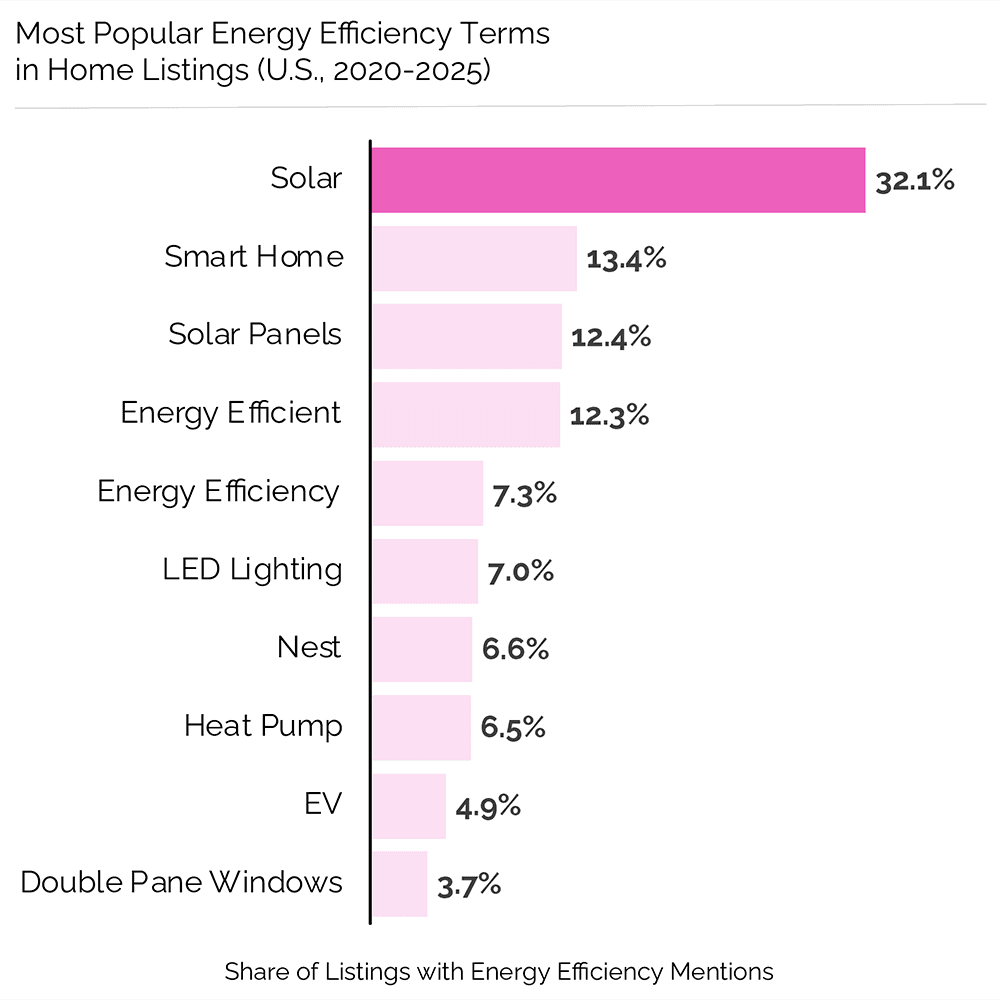
Also promising is the fact that the generic term “energy efficient” beat most specific technology claims (e.g., LED lighting, Nest, heat pump), suggesting that there's genuine, if not well-formed, interest in the topic from both sellers and buyers.
Solar stands out while heat pumps are hidden, literally and figuratively
Rooftop solar is the exception. It’s the one specific energy-efficient asset frequently highlighted in listings when available, and the only term from 2020-2025 more popular than general descriptors like “energy efficiency” and “smart home.”
Looking again at homes sold between 2024-2025, solar was mentioned in 67% of the listings where it was actually present on the property. And examining listings from 2020-2025 with at least one energy efficiency-related term, it was by far the most-mentioned at 32%.
For solar installers, this finding is very powerful: homeowners who purchase solar will recapture a meaningful part of their investment when they later sell their home.
Still, one-third of all solar homeowners don’t advertise their systems when selling, so as an installer, it remains crucial to articulate the different ways your customers can make money back from their investments, including resale.
Meanwhile, in 2024-2025, listings included heat pumps just 8% of the time they were available, exposing a huge awareness gap despite policy tailwinds in many parts of the country.
This may be because heat pumps are simply easier to overlook than, say, rooftop solar or EV chargers (especially for the real estate agents writing the listings).
The complete “Home Buying in the Energy Transition” study shows that realtors perceived a lack of buyer interest. But buyers are interested, and homeowners who “hide” their heat pumps are leaving thousands of dollars on the table.
HVAC contractors now have an opportunity to teach their customers just how valuable heat pumps are, saving $300-650 in electricity per year and earning back up to $4K on the sale of one’s home.
Our research methodology
257 is a customer intelligence platform for the residential energy market. We profile hundreds of property, demographic, and energy characteristics for all 130M homes in the U.S., allowing companies to reimagine customer acquisition and engagement through personalization and precision targeting.
Our AI-powered ‘digital energy twins’ are trained on billions of relevant data points from hundreds of data sources, including residential real estate listings and transactions.
To start, we analyzed 143 million property listings nationwide from 1995-2025 for mentions of “energy efficiency” and specific clean energy features, including rooftop solar, heat pumps, battery storage systems, electric vehicle (EV) chargers, smart thermostats, smart appliances, and more.
We then performed two causal inference studies to learn if including solar- or heat pump-related language in a listing increased sale price.
We used our models to identify U.S. homes with solar or heat pumps sold between 2024-2025, then analyzed their associated listings and final sale prices.
For each study, we divided the homes into two groups: one with listings explicitly mentioning solar or heat pumps at least once, and listings with no such mentions. In both cases, we knew the home to have had these features, whether or not they were mentioned.
A clearer way to calculate heat pump and rooftop solar system ROI
As federal energy efficiency incentives narrow, the onus is on solar installers, HVAC contractors, and OEMs to help consumers understand the payback on large home improvements.
This is especially relevant for homeowners who anticipate moving within 10-15 years of installing these products, given the payback window for these improvements.
Our data shows:
A meaningful appetite among today’s homebuyers for rooftop solar, high-efficiency heat pumps, and other assets,
A clear path for homeowners to recoup a quarter to a third of their investments, and
A valuable opportunity for home energy installers to highlight the ROI for their customers.
257 doesn't just provide market insights; we leverage this data to help our clients acquire the right customers more efficiently.
Companies use 257’s customer intelligence platform to identify the households in their territory most likely to adopt solar, heat pumps, or other energy products and services and target these exact households across the media landscape.
Pink is the conversational interface to 257’s platform that anyone can use, regardless of technical background. Audience insights are free, and when you use them for your ad campaigns on Google, Meta, direct mail, or other media, you pay only on results.
Try it today!
Homebuyers pay up to $10K more for energy efficiency, and other learnings from analyzing 143 million property listings
Here at 257, we work with hundreds of companies across the U.S. who share our mission to accelerate residential electrification and the clean energy transition.
These companies offer solar, storage, heat pumps, financing, energy management tools, and more – all to lower their customers’ energy bills and build a stronger grid.
The loss of federal incentives for home energy upgrades has made it all the more important to quantify the ROI of these impactful but investment-grade products.
According to EnergySage, while upfront installation costs vary widely, a U.S. homeowner today pays around $30,500 for rooftop solar and $14,529 for a ducted heat pump before incentives.
Data nerds that we are, we embarked on a study to learn if, in addition to near-term bill savings, large home energy improvements like rooftop solar and heat pumps would attract homebuyers and improve home values.
What we found: homebuyers seek out energy-efficient homes, and are willing to pay more for them.
This presents an untapped opportunity for solar installers, HVAC contractors, and manufacturers to educate prospective customers on the true value of their investments and help them capture thousands of dollars more when they sell their homes.
Our research and key findings
We analyzed 143 million U.S. home listings nationwide from 1995-2025 for mentions of “energy efficiency” and specific clean energy features.
We then performed two causal inference studies to learn if including solar- or heat pump-related language in a listing increased sale price.
Our findings are part of a larger report, “Home Buying in the Energy Transition,” released by the Smart Energy Consumer Collaborative (SECC) with additional insights from the National Association of REALTORS® and E Source.
You can download the full report for free here, or read on for the 257 highlights. You can also find more detail on our methodology toward the end of this article.
Homebuyers pay measurably higher sale prices for solar and heat pumps
Our analysis showed that on average, for homes with solar panels sold between 2024-2025, listings that explicitly mentioned solar garnered a 2% uptick in the final sale price, or the equivalent of +$10K per home (approximately one-third of the cost of a rooftop solar system) on a median sales price of $557K.
Meanwhile, for homes with ducted heat pumps that sold between 2024-2025, listings that mentioned heat pumps were also associated with higher sale prices, selling for 0.6% to 1% more, on average, or +$2.3K to +$3.9K per home (16-27% of a ducted heat pump investment) on a median sales price of $399K.
Put another way, when real estate listings clearly advertised solar or heat pumps, they commanded higher sale prices compared to similar homes that also had these features but failed to market them.
This suggests that homebuyers not only appreciate energy efficiency – given surging energy rates and growing affordability concerns across the nation, they actively seek it out when shopping for a new home.
In fact, our “Home Buying in the Energy Transition” co-contributor E Source found that 61% of recent homebuyers ranked energy efficiency as a top-3 consideration when house hunting.
92% of real estate listings don’t mention energy-efficient assets
But based on our research, current homeowners underestimate the appeal of their energy-efficient assets. Despite the proven financial advantages of advertising energy efficiency, only 8% of 2025 listings did so.
Meanwhile, approximately 25% of U.S. residences have at least one large or particularly impactful asset such as solar, storage, a heat pump, smart thermostat, or EV charger, and millions more have LED lighting, insulation, smart appliances, and other tech that improves efficiency in some way, big or small.
Said another way: only one-third of listings that can boast energy efficiency actually do.
Encouragingly, the share of listings with any energy efficiency mentions nearly tripled between 2015 and 2025 (+186%), indicating not only that adoption of these features has accelerated but that homeowners are becoming more aware of the market for them.
Also promising is the fact that the generic term “energy efficient” beat most specific technology claims (e.g., LED lighting, Nest, heat pump), suggesting that there's genuine, if not well-formed, interest in the topic from both sellers and buyers.
Solar stands out while heat pumps are hidden, literally and figuratively
Rooftop solar is the exception. It’s the one specific energy-efficient asset frequently highlighted in listings when available, and the only term from 2020-2025 more popular than general descriptors like “energy efficiency” and “smart home.”
Looking again at homes sold between 2024-2025, solar was mentioned in 67% of the listings where it was actually present on the property. And examining listings from 2020-2025 with at least one energy efficiency-related term, it was by far the most-mentioned at 32%.
For solar installers, this finding is very powerful: homeowners who purchase solar will recapture a meaningful part of their investment when they later sell their home.
Still, one-third of all solar homeowners don’t advertise their systems when selling, so as an installer, it remains crucial to articulate the different ways your customers can make money back from their investments, including resale.
Meanwhile, in 2024-2025, listings included heat pumps just 8% of the time they were available, exposing a huge awareness gap despite policy tailwinds in many parts of the country.
This may be because heat pumps are simply easier to overlook than, say, rooftop solar or EV chargers (especially for the real estate agents writing the listings).
The complete “Home Buying in the Energy Transition” study shows that realtors perceived a lack of buyer interest. But buyers are interested, and homeowners who “hide” their heat pumps are leaving thousands of dollars on the table.
HVAC contractors now have an opportunity to teach their customers just how valuable heat pumps are, saving $300-650 in electricity per year and earning back up to $4K on the sale of one’s home.
Our research methodology
257 is a customer intelligence platform for the residential energy market. We profile hundreds of property, demographic, and energy characteristics for all 130M homes in the U.S., allowing companies to reimagine customer acquisition and engagement through personalization and precision targeting.
Our AI-powered ‘digital energy twins’ are trained on billions of relevant data points from hundreds of data sources, including residential real estate listings and transactions.
To start, we analyzed 143 million property listings nationwide from 1995-2025 for mentions of “energy efficiency” and specific clean energy features, including rooftop solar, heat pumps, battery storage systems, electric vehicle (EV) chargers, smart thermostats, smart appliances, and more.
We then performed two causal inference studies to learn if including solar- or heat pump-related language in a listing increased sale price.
We used our models to identify U.S. homes with solar or heat pumps sold between 2024-2025, then analyzed their associated listings and final sale prices.
For each study, we divided the homes into two groups: one with listings explicitly mentioning solar or heat pumps at least once, and listings with no such mentions. In both cases, we knew the home to have had these features, whether or not they were mentioned.
A clearer way to calculate heat pump and rooftop solar system ROI
As federal energy efficiency incentives narrow, the onus is on solar installers, HVAC contractors, and OEMs to help consumers understand the payback on large home improvements.
This is especially relevant for homeowners who anticipate moving within 10-15 years of installing these products, given the payback window for these improvements.
Our data shows:
A meaningful appetite among today’s homebuyers for rooftop solar, high-efficiency heat pumps, and other assets,
A clear path for homeowners to recoup a quarter to a third of their investments, and
A valuable opportunity for home energy installers to highlight the ROI for their customers.
257 doesn't just provide market insights; we leverage this data to help our clients acquire the right customers more efficiently.
Companies use 257’s customer intelligence platform to identify the households in their territory most likely to adopt solar, heat pumps, or other energy products and services and target these exact households across the media landscape.
Pink is the conversational interface to 257’s platform that anyone can use, regardless of technical background. Audience insights are free, and when you use them for your ad campaigns on Google, Meta, direct mail, or other media, you pay only on results.
Try it today!

Copyright © 2025 257.co | All Rights Reserved |
Copyright © 2025 257.co | All Rights Reserved